20th Century Propaganda: Jim Crow and Nazi Germany
ABOUT THIS LESSON
Introduction
Exploring propaganda’s use and effects in the past and present, with a particular focus on Nazi and racist propaganda. The propaganda used by the German Nazi Party in the years leading up to and during the Nazi regime (1933–1945) was essential for gaining and maintaining power, and for the implementation of Nazi policies. Nazi propaganda is one major example of information being disseminated in the public to influence or control large groups of people. Other forms of propaganda include, but are not limited to, anti-Black U.S. propaganda during the Jim Crow era and other forms of racist propaganda we see today in different outlets and platforms. Tying the past and the present demonstrates how propaganda comes in different forms, and we why must learn how to recognize and consider it with a critical lens.
Guiding Questions
- What is propaganda?
- What are the similarities between antisemitic and racist propaganda?
- How was propaganda used to gain power and influence public opinion?
Lesson Components
Part One
- Warm Up (10 mins)
- Introduction to Historical Propaganda (20 mins)
- ACTIVITY: Propaganda Explored: Analyzing Historical Propaganda (20 mins)
- Reflection (10 mins)
Part Two (optional)
PART ONE
1. Warm Up (10 mins)
Definition: Propaganda involves the spreading of information and ideas to influence an audience and further an agenda. Propaganda uses truths, half-truths and/or lies, as it selectively presents information in order to shape public opinion.
Begin the lesson with the two propaganda images below. Have students work in small groups to answer the following questions:
- What are the similarities and differences between these two examples of propaganda?
- Who is being portrayed?
- How are they displayed?
- Who is the target audience and what are they being told about the subject?
Come together as a class and share observations.
The two images below are two suggestions. You can use these suggested images or choose alternative propaganda from the US Holocaust Memorial Museum and the Jim Crow Museum
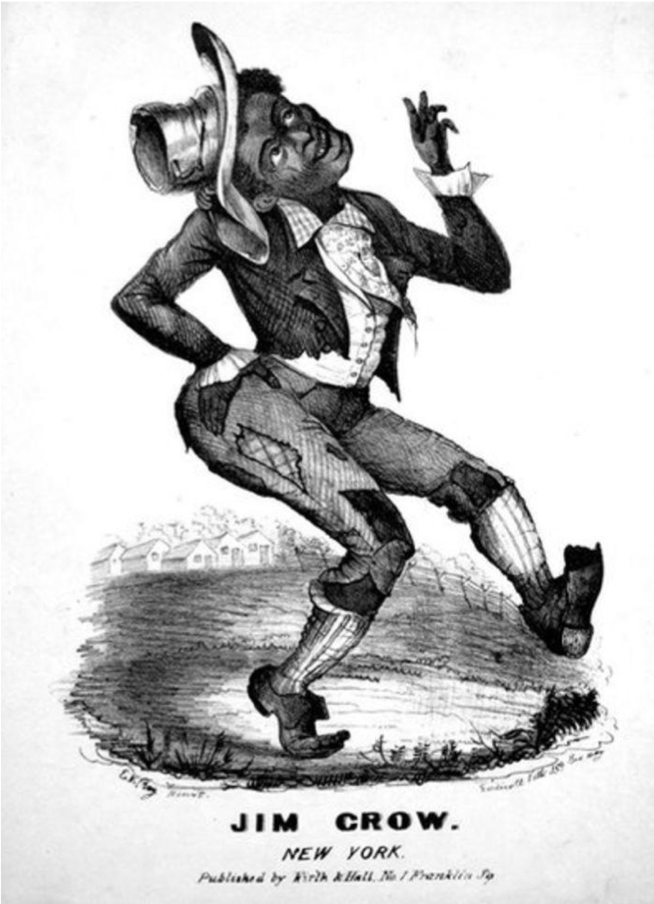
The cover to an 1832 edition of the sheet music of Jump Jim Crow, which depicts a stereotyped African-American known as Jim Crow.
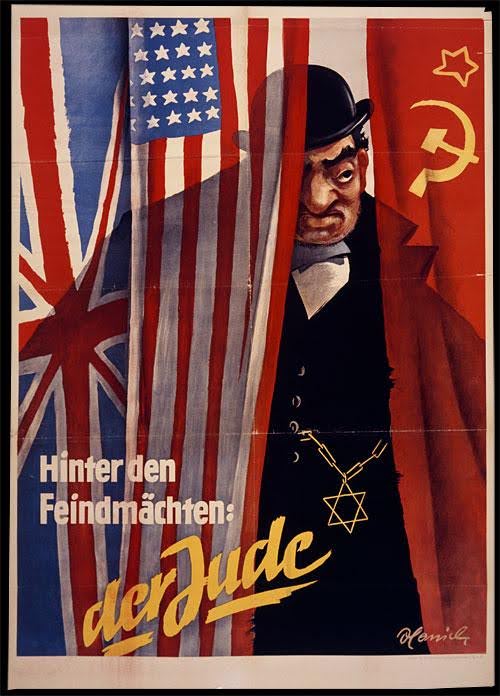
“Behind the Enemy Powers: The Jew.” 1942. USHMM Collection.
2. Introduction to Historical Propaganda (20 mins)
Historic Context
Have students read full context as a group or independently. A printable PDF handout of the Historic Context can be found in the sidebar.
The history of propaganda and its use is long and complicated. There is a common misconception that propaganda is new and modern, but in fact, the use of propaganda is as old as recorded history. Though lacking the technology we use today such as newspapers, radio, and film, ancient civilizations were just as determined to influence the public through propaganda in the form of games, theater, assemblies and festivals. In ancient Greece for example, Greeks excelled at influencing public opinion through public speeches and gatherings, as well as circulating handwritten books. From that time forward, many societies made use of propaganda means of controlling how and what kind of information the public could access.
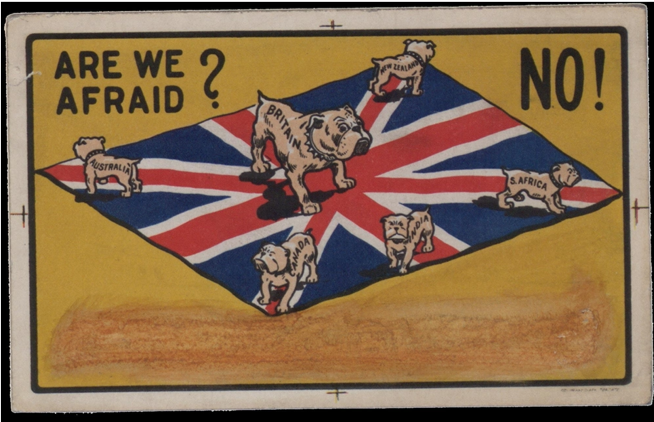
A propaganda postcard depicting the British Empire. 1915. British Library.
Mass propaganda started with the invention of the movable type printing press in the time of the Reformation making it possible to reproduce media and distribute information to a large audience rapidly. The use of propaganda dramatically increased in the 20th century, especially during the Nazi era, when hateful ideologies could spread using new technologies, like motion pictures and radio. While almost every country has used propaganda to unite its people in wartime, the Nazis were notable for making propaganda a key element of party formation and the government.
Early on, Adolf Hitler believed that British propaganda during WWI was instrumental and a primary cause of Germany’s defeat. One of the earliest pieces of Nazi propaganda is Hitler’s 1925 book, Mein Kampf, in which he dedicated two chapters to the study and practice of propaganda. He claimed he learned its value as a World War I soldier who was exposed to very effective British propaganda and ineffective German propaganda. In Mein Kampf he wrote, “the great masses of the people will more easily fall victims to a big lie than to a small one.” Hitler put these ideas into practice in the early years of the Nazi Party’s development with the establishment of Nazi newspapers including, Völkischer Beobachter in 1920 and Joseph Goebbels’s Der Angriff in 1927.
A former journalist and Nazi party officer in Berlin, Joseph Goebbels became instrumental in the Nazi propaganda machine. In 1930, Hitler appointed Goebbels as the head of party propaganda. Goebbels served as the Reich Minister of Propaganda of Nazi Germany from 1933 to 1945. As the central office of Nazi propaganda, the Reich Ministry of Public Enlightenment and Propaganda comprehensively supervised and regulated culture and mass media of Nazi Germany. It was responsible for controlling the German news media, literature, visual arts, filmmaking, theatre, music, and broadcasting.
The Nazis wanted Germans to support and believe exclusively in Nazi ideas and so controlled all forms of communication and media consumption through a combination of censorship and propaganda. One major part of this campaign were the Nazi book burnings of 1933, in which more than 25,000 books that the Nazis categorized as un-German were burned. The Nazi regime centralized propaganda efforts through the Ministry of Propaganda and used a variety of mediums to spread Nazi ideas. Examples included:
- Glorifying Adolf Hitler as a heroic leader by playing his speeches and producing posters and photographs of him as a strong leader;
- Spreading negative images and ideas about Jews in magazines, films, cartoons, posters, and other forms of media;
- Making radios affordable so that more Germans could purchase them to listen to Nazi ideas and broadcasting speeches on the radio;
- Organizing large and celebratory Nazi Party rallies;
- Producing massive propaganda films as tools to distract the public, spread ideas of the “master Aryan race,” and portray Jews and other racial minorities as “subhuman”;
- Setting up the Theresienstadt model camp to mislead the public and discredit reports of genocide (See our IWalk tour on Propaganda & Antisemitism for further context).
While Nazi propaganda aimed to mobilize Germans under the Nazi party, it most also tried to create a race consciousness among German populations. Films played an important role in presenting the ideal image of a superior Aryan German race, in contrast to non-ethnic Germans who were “subhuman” and inferior. Newspapers in Germany such as Der Stürmer, printed cartoons that used antisemitic caricatures to depict Jews and promote racial antisemitism.
Historians have noted that the treatment of African-Americans in the United States, particularly the Jim Crow American South, struck Hitler as an example to be emulated. Anti-black imagery in the form of racist caricatures and the vilification of black men in Hollywood films undoubtedly influenced antisemitic propaganda imagery used by the Nazi party. American eugenicists made no secret of their racist objectives, similar to the Nazis. For Nazi observers, ethnic and racial cleansing was justified and a necessary means to accomplish the Nazi agenda.
Propaganda, Education & the Youth
As a class, watch a small portion of Why Did The German People Choose Hitler?: Hitler’s Propaganda Machine. Begin at the 20:02 time stamp and end at 27:14. (7:12 minutes)
Critical Questions
Once students have read the context and watched the video clip, facilitate a discussion using up to 3 of the following questions.
- What is propaganda and how was it used prior to the 20th century?
- How was propaganda used in the Nazi-era to manipulate public opinion?
- What are some of the platforms used to present propaganda?
- Why was it important for the Nazi party to combine censorship with propaganda? How did this combination promote their cause?
- Who are usually the primary victims/targets of propaganda?
- How has propaganda been used to spread hate and bigotry?
3. ACTIVITY: Propaganda Explored: Analyzing Historical Propaganda (20 mins)
Break your class into groups. For each group, assign a pair of propaganda images provided in the student Propaganda Explored handout in the sidebar. Each pair will focus on a particular theme and consists of one example of Nazi propaganda and one example of another form of historical propaganda from the United States.
Have students think about the following sets of questions. Direct students to look at the captions for foundational context:
- WHEN is this from?
- WHERE is it from?
Then students should then discuss these more challenging questions:
- WHO is this about? Who does this message benefit, and who does this message hurt?
- WHAT idea, message or product are you being sold?
- HOW are the two or three images similar and/or different?
Come together as a class to report each group’s findings.
4. Reflection (10 mins)
As a class discuss that propaganda is not stuck in the past. Through media consumption – whether that be newspapers, television shows, advertisements, memes, or gifs on social media- everyone is confronted with images daily that are meant to influence our views and opinions. In order to make sure we do not fall victim to bigoted images and messages, we must think critically of what we see.
Teachers can offer up to 3 of the following questions to students in the Reflection Questions handout (on the sidebar) to respond to in writing or in a discussion.
- The Nazi Ministry of Propaganda had control of all media: newspapers, books, video, radio, art, music, advertising, etc. Why was it so important to have total control of what people read or saw?
- What kinds of technology do we have today to spread information that was not available in WWII?
- When you see news, a story, or an image online, how do you know it is accurate or true? What steps can you take to discern fact from opinion?
- Where have you seen propaganda in your own life? What do you do when you see hateful imagery online? What steps can you take to address it?
- Think about current events pertaining to the experiences of BIPOC (black, Indigenous and people of color) in the United States. Choose an example in which racial minorities in the United States have been dehumanized and compare these depictions with any example of historical propaganda. Examples to choose from include:
- Muslims in the United States after 9/11
- Criminalization of Black People and Police Brutality
- Stereotyping of Latinx Americans as Undocumented Immigrants and ICE
- Anti-Asian Violence and COVID-19
As a class watch “Confronting Hate Propaganda and Holocaust Denial” (4:40) from the United States Holocaust Memorial Museum. This video provides an overview of the Museum’s propaganda initiative in light of online propaganda threats
If you have time, please continue to the optional second part of the lesson which connects historical propaganda to present-day propaganda and racist imagery. Students should look at Antisemitism Explained to further discuss media literacy – identifying racist and antisemitic imagery
Part Two (Optional)
1. Virtual or In Person IWalk — Propaganda & Antisemitism (45min)
Teachers may choose to add a virtual or in person tour of the Horwitz-Wasserman Memorial Plaza to enhance student understanding of the lesson context. Note that a tour will add an additional 45 minutes to 1.5 hours to the lesson. In order to complete this IWalk, have students download the IWalk app (instructions found here).
The Propaganda IWalk explores the Nazi Propaganda Ministry and its activities at length. This IWalk discusses Nazi symbols as they were used historically and by white supremacists today. It utilizes testimony from survivors reflecting on propaganda in the past and present. This IWalk also describes the Theresienstadt camp, a site that was used to promote a false image about how Jews and other target groups were treated in preparation for a visit from the Red Cross, the Nazis disguised the conditions of the Theresienstadt ghetto to portray an atmosphere of normalcy. Prisoners were forced to plant gardens, paint housing complexes, renovate barracks and host cultural events. The propaganda film, Theresienstadt (1944) was also produced, in which Jews were displayed as happy and healthy in “Jewish Settlement Areas.”
2. Reflection
Teachers can offer up to 3 of the following questions to students in the Reflection handout (on the sidebar) to respond to in writing or in a discussion.
- The Nazi Ministry of Propaganda had control of all media: newspapers, books, video, radio, art, music, advertising, etc. Why was it so important to have total control of what people read or saw?
- What kinds of technology do we have today to spread information that was not available in WWII?
- When you see news, a story, or an image online, how do you know it is accurate or true? What steps can you take to discern fact from opinion?
- Where have you seen propaganda in your own life? What do you do when you see hateful imagery online? What steps can you take to address it?
- Think about current events pertaining to the experiences of BIPOC (black, Indigenous and people of color) in the United States. Choose an example in which racial minorities in the United States have been dehumanized and compare these depictions with any example of historical propaganda. Examples to choose from include:
- Muslims in the United States after 9/11
- Criminalization of Black People and Police Brutality
- Stereotyping of Latinx Americans as Undocumented Immigrants and ICE
- Anti-Asian Violence and COVID-19
3. Independent Research
Teachers can offer these questions to students in a handout (on the sidebar) to respond to in writing or in a discussion.
- Think about media bias and how the media shows specific perspectives. Choose an event and look at how it was discussed on various news outlets. For example, think about how the British and American news would report on the American Revolution.
- Take a look at some of our beloved authors and movies of the past. In the past, Disney and Dr. Seuss both produced harmful imagery and have made recent efforts to right their wrongs. Do you think these organizations succeeded in recognizing their past wrongs and held themselves accountable?
- Dr. Seuss Enterprises – the publishing company handling Dr. Seuss’ legacy- recently decided to discontinue publication of several books with stereotyped imagery of Black, Asian and Jewish characters Read their statement and reflect on this approach.
- Look into the history of Disney WWII propaganda, as well as animated films that have perpetuated stereotypes (for example, Mulan and Peter Pan).
- How has Disney responded?
- How did the company change for the remake of Mulan, or its portrayal of indigenous communities in more recent movies?
- Disney has added disclaimers to a number of films. Reflect: is this enough acknowledgement? Should the movies be taken off online streaming?
- Take a look at the Freedom Forum’s Today’s Front Page. What do you notice about the news that makes the front page in your city as compared to your state? What about the state compared to the rest of the country? What about compared to other parts of the world?